
What if changing the world was more like caregiving than war?

Image: Matt Palmer (Unsplash)
“Maybe changing the world is more like caregiving than it is like war. Too many people still expect it to look like war…”
When I was a kid, my mum was part of a group called Mothers and Others for Peace; a group of women who sat themselves firmly “amongst the nappies and the sticky buns” and worked for a world without war.
Their activism took many forms and their understanding of the culture of violence traversed many terrains. Among other things they collected boxes of food and toiletries to send to refugees from Sarajevo, they campaigned for children’s clothing brands to remove weapons and guns from ‘boys’ clothing, and they met with politicians.
My favourite event that those of us ‘others’ (the children) still talk about was a particular protest they were involved in to shut down the AIDEX arms bazaar in Canberra. What we all love about this action is that the mothers attended in their dressing gowns waving beautiful banners they’d made out of our cloth nappies. My mum’s was particularly gorgeous with a series of four nappies that showed the progression of a tank being turned into a toy train.
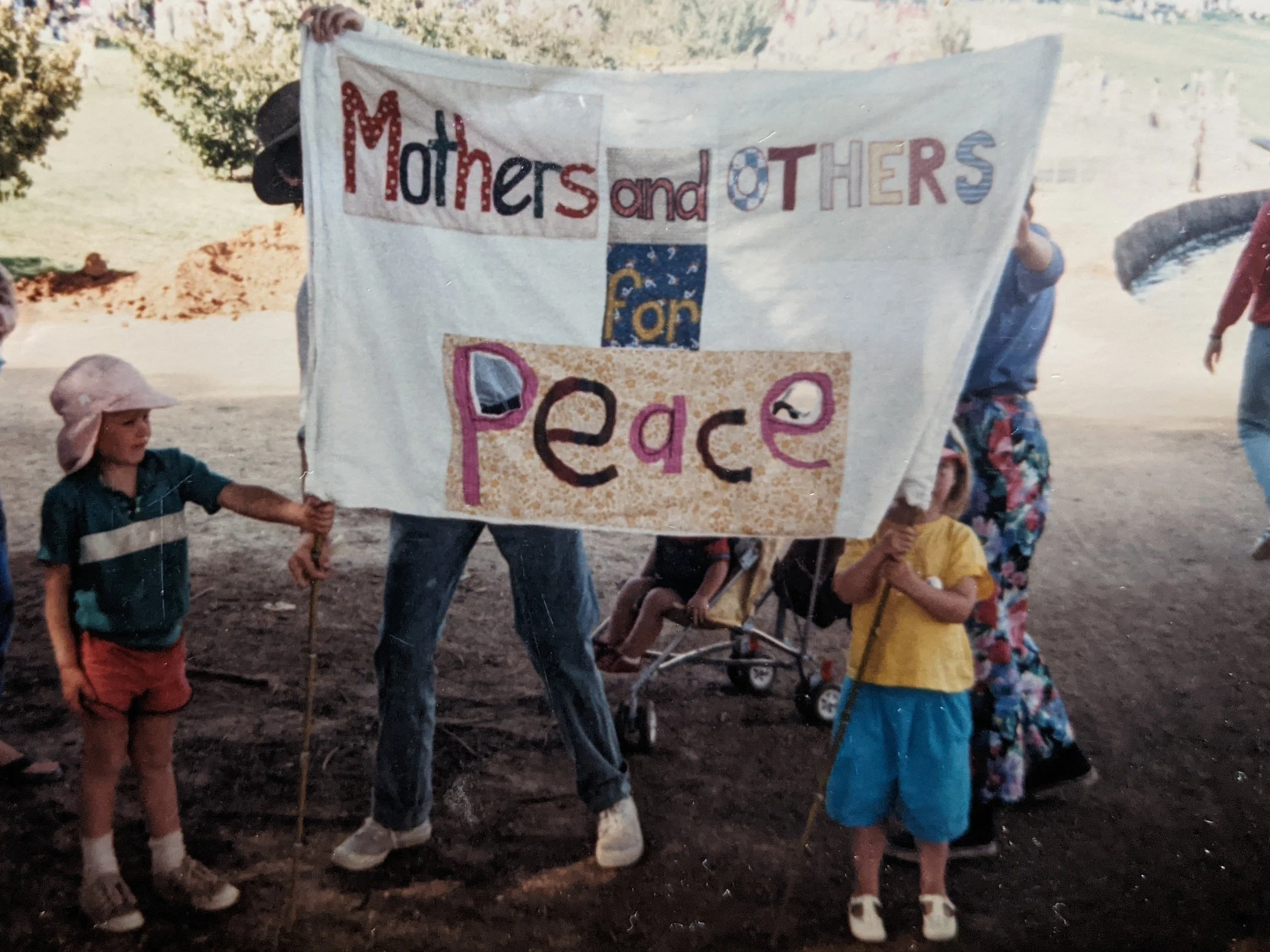
Dylan (left) and Millie (right) holding a banner that their mum’s made.
I think about these women a lot at the moment and what they taught me about peace and care and politics. Care was at the very heart of their activist work. Care for us kids and the world they wanted us to live in, and care and solidarity and recognition of sameness with other mothers across the globe. Their politics was grounded in who they were as parents and who they were as human beings in a wider world.
They also drank a lot of tea and ate a lot of cheap sticky-buns.
And as you know, we’re pretty firm here that the coffee (or tea) is work.
If changing the world is more like caregiving than war, then we must get to the work of care. The work of care is so many things. It is changing nappies and changing IV drips, it is planting trees and weeding wetlands. Care is being a shoulder to cry on and turning up in gumboots to clear flood debris. Care is fighting fires and changing policies so that fossil fuels stay in the ground. Care, in the way we’re talking about it is work and it is work that we do for all of us.
Care, like war, involves strategy. It involves being able to pre-empt needs, understand the impact of actions, and ensure alternatives are in place should something go wrong. In war, it is important to know your enemy. In care, it is important to know your friends.
As we’ve written about in our Care through Disaster work, knowing our neighbours and our communities is essential infrastructure that is built over time and via inefficient interactions. Coffee with friends, participating in a local playgroup, attending Park Run, using public picnic tables and regularly going to the library are all important both in their own right as lovely things to do and in the service of building connection. And of course this can happen online too as those with limited capacity to leave the house or engage in the physical world build places and spaces of community and connection across the internet.
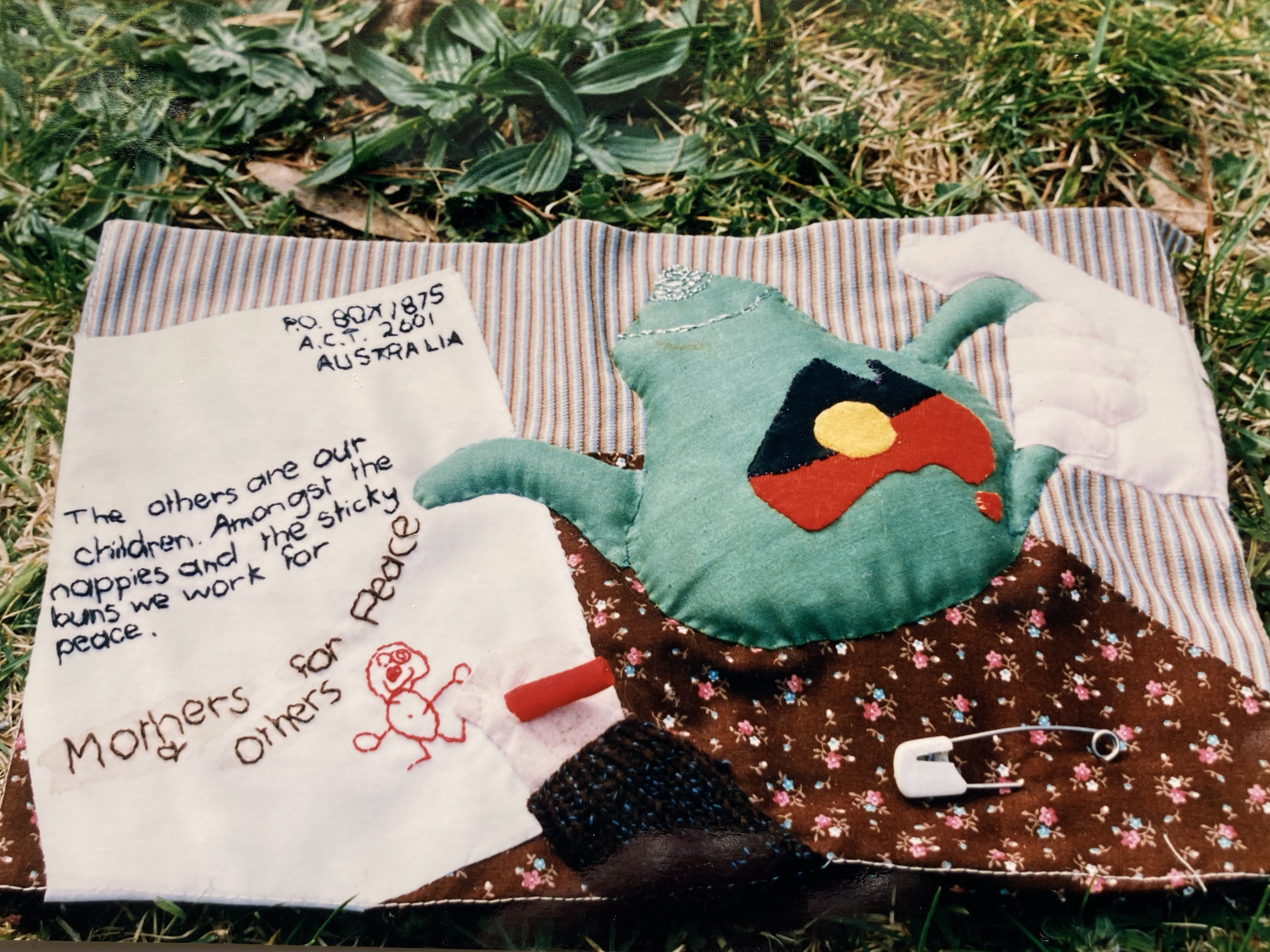
The Mothers and Others contribution to the Mothers for Peace quilt
It is because of the very power of connection that those seeking to hoard power and wealth intentionally set out to create disharmony and disconnection.
In 1969 Kevin Phillips, a Harvard graduate, published a book called The Emerging Republican Majority. This book articulated a simple and effective strategy (he didn’t invent it, it had been around a while) that involved stoking the issues of identity and grievance in order to split and fragment communities. It was an intentional strategy to smash social cohesion and drive power towards the Republican party.
Dividing us is an intentional strategy. As is the chaotic discombobulation that we feel when major ‘unprecedented’ event follows major ‘unprecedented’ event.
Trump’s former Chief Strategist, Steve Bannon, has been open about the weaponisation of chaos. He calls this ‘flooding the zone’, that is, creating enough noise and chaos to distract, overwhelm and paralyse people from pushing back and from contributing to the things that really matter (the ABC has a great little explainer article on this).
The intentional creation of chaos is a strategy designed to strip us of our power. But we don’t have to buy it. We literally do not need to pay any money to take it back.
Capitalism, neoliberalism and the people wielding these systems for profit and power gain when we allow ourselves to be sliced and diced into overwhelmed and isolated individuals. And so responding by actively connecting, actively building relationships becomes essential work.
Big clever thinkers and makers across the globe are pointing us in this direction, arguing that community connection is essential groundwork for bigger political projects and for building collective power.
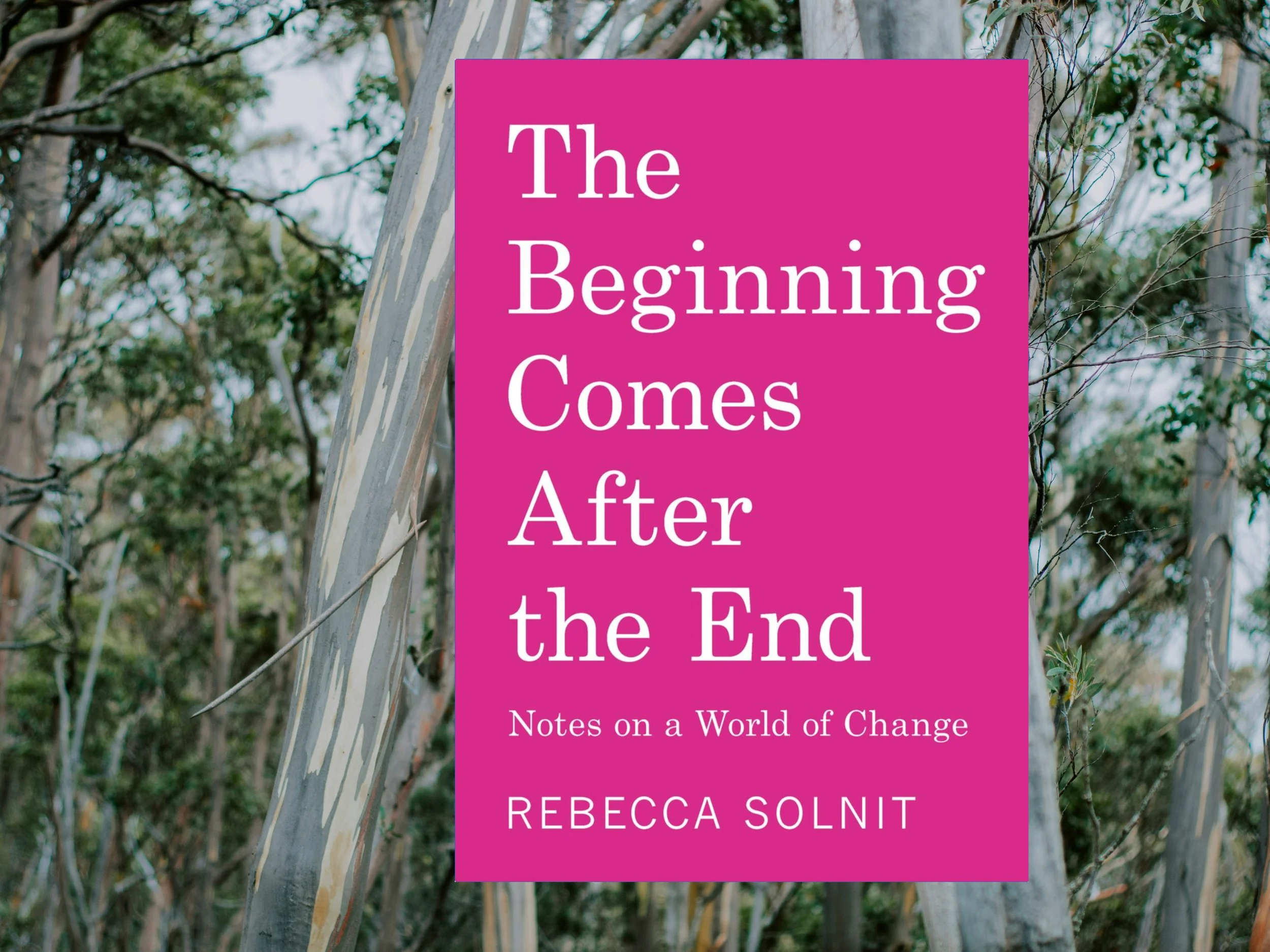
One of our favourite writers Rebecca Solnit has a new book – The Beginning Comes After the End, Notes on a World of Change. As always it is clear and hopeful without ignoring the very many troubling realities of our time. Solnit writes about how the revolutions in the last 70 years have gained strength and focus through the recognition of connection, and how much of what is happening now is a response to this. Solnit writes: "The backlash seeks a return to hierarchy and segregation, to a world where some people and kinds of people matter more than others, which then legitimises cruelty and exclusion and oppression to keep them in their place and the minority on top". She continues,"Perhaps a worldview in which interconnection is a fundamental principle, in which your own thriving depends on the thriving of those people and systems around you, might alter the emotional and spiritual poverty of a worldview driven by notions of scarcity and competition".
Knowing those around us, seeing each other as humans is surely an important way to remember that we cannot escape our connections.
The coffee is the work. It is not all of the work, but it is an essential piece.
And relationships have material impact. A belief in interconnection and the inherent value of human life is evident in the extraordinary community response to the ICE raids in Minnesota. Thomas L. Friedman writes that people are calling this ‘neighbouring’, “a spontaneous uprising of civic activism propelled by a single idea - I am my neighbour’s keeper, whoever he or she is and however he or she got here”. He explains people were propelled by the idea of ‘neighbouring’ meaning “Today I will be neighbouring - going out to protect the good people next door or down the block. Not because I favour illegal immigration, but because I oppose the fundamental indecency of President Trump and Stephen Miller… trying to fulfill their daily quota for evicting illegal immigrants by arresting my neighbours, most of whom work hard, pay taxes, go to church or mosque and help me dig out my car from the snow in winter”.
Neighbouring is the work. And neighbouring can give us a gateway to activating each other for bigger change.

Image: Matt Palmer (Unsplash)
My mum is still in touch with the ‘mothers’ and I am still good friends with some of the ‘others’ many of whom are continuing to work for peace and justice and a safe climate. I know that these women worry that the work they did is being undone, and that their efforts were for nothing, but that could not be further from the truth.
As Solnit writes in Hope in the Dark:
Cause and effect assumes history marches forward, but history is not an army. It is a crab scuttling sideways, a drip of soft water wearing away stone, an earthquake breaking centuries of tension. Sometimes one person inspires a movement, or her words do decades later; sometimes a few passionate people change the world; sometimes they start a mass movement and millions do; sometimes those millions are stirred by the same outrage or the same ideal and change comes upon us like a change of weather.
The lessons from these ‘mothers’ are woven into who I am. These women were a key part of teaching me that care is hard, that it goes beyond the home and out into the world, that it is strategic and funny and creative, and that the cuppa is well and truly a part of the work.
Millie

Image: Eric Prouzet (Unsplash)